
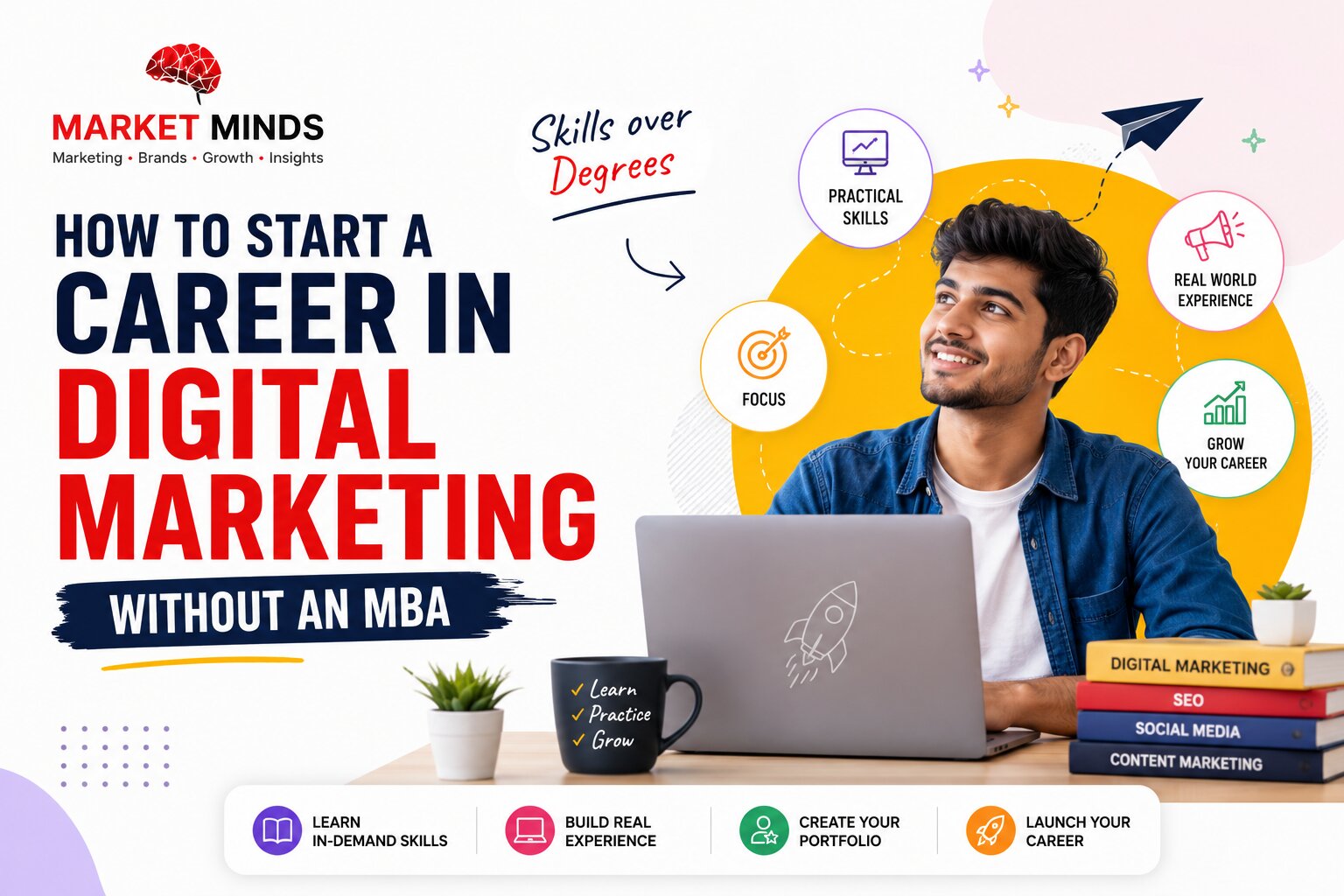
How to Start a Career in Digital Marketing Without an MBA

AI Summary
Digital marketing is one of the few career fields where practical skills often matter more than academic degrees. While an MBA can provide business knowledge, it is not a mandatory requirement to build a successful marketing career. Employers today focus on hands-on experience, tool proficiency, problem-solving ability, and measurable results. With businesses rapidly moving online, opportunities in digital marketing continue to grow across industries. Students and freshers from any educational background can enter the field by learning relevant skills, building projects, and gaining real-world experience.
One of the biggest myths about marketing is that you need an MBA to build a successful career.
The reality is quite different.
Many of today’s top digital marketers, growth hackers, SEO experts, content strategists, and performance marketers never pursued an MBA. Instead, they built practical skills, gained hands-on experience, and continuously adapted to industry changes.
In fact, digital marketing is one of the few professions where employers often value skills, results, and experience more than academic qualifications.
If you’re a student, fresher, engineer, commerce graduate, BCA student, B.Sc graduate, or even someone looking to switch careers, this guide will show you exactly how to start a career in digital marketing without an MBA.
Is an MBA Required for Digital Marketing?
The short answer is no.
An MBA can certainly help you understand business concepts, management principles, and strategy. However, digital marketing is a highly practical field.
When hiring, most companies care about:
• What tools you know
• What campaigns you have worked on
• What results you have achieved
• Your ability to learn quickly
• Your problem-solving skills
A candidate with practical experience often has an advantage over someone with only theoretical knowledge.
Why Digital Marketing Is an Attractive Career
The digital economy continues to grow rapidly.
Every business wants:
• More website traffic
• More leads
• More customers
• Better brand awareness
• Higher online sales
As a result, digital marketers are needed across almost every industry.
Digital marketing offers:
• Strong career growth
• Multiple specialization options
• Remote work opportunities
• Freelancing possibilities
• Entrepreneurship opportunities
• Continuous learning
Most importantly, you can start learning immediately.
Step 1: Understand the Different Areas of Digital Marketing
Before learning anything, understand the major branches of digital marketing.
Search Engine Optimization (SEO)
Improving website visibility on search engines like Google.
Content Marketing
Creating blogs, guides, videos, and educational content.
Social Media Marketing
Managing platforms such as Instagram, LinkedIn, Facebook, X, and YouTube.
Performance Marketing
Running paid advertisements on Meta, Google, LinkedIn, and other platforms.
Email Marketing
Building customer relationships through email campaigns.
Marketing Automation
Using technology to automate marketing processes.
Analytics
Measuring and interpreting marketing performance.
Spend time exploring each area before choosing your preferred specialization.
Step 2: Learn the Fundamentals of Marketing
Before jumping into tools, understand how marketing works.
Start learning:
• Marketing Funnel (TOFU, MOFU, BOFU)
• AIDA Model
• Consumer Psychology
• Branding Basics
• Customer Journey
• Lead Generation
• Marketing Metrics
Many freshers learn tools but ignore marketing principles.
The best marketers understand both.
Step 3: Learn Essential Marketing Tools
Every beginner should become comfortable with a few key tools.
Google Analytics
Understand website traffic and user behavior.
Google Search Console
Monitor SEO performance.
Canva
Create professional graphics and presentations.
ChatGPT
Content creation, research, brainstorming, and productivity.
Meta Ads Manager
Learn Facebook and Instagram advertising.
Google Ads
Understand search and display advertising.
Excel
A highly underrated skill for marketers.
You don’t need to master everything immediately.
Focus on understanding the basics first.
Step 4: Complete Industry Certifications
Certifications demonstrate initiative and help build confidence.
Some valuable certifications include:
Google Analytics Certification
Learn website analytics and reporting.
Google Ads Certification
Understand paid advertising fundamentals.
HubSpot Certifications
Content marketing, email marketing, CRM, and inbound marketing.
Meta Blueprint
Learn Meta advertising and campaign management.
Semrush Academy
SEO and digital marketing certifications.
Most of these certifications are free.
Step 5: Build Your Personal Brand
One of the best ways to stand out is to market yourself.
Create a LinkedIn profile.
Share:
• Marketing learnings
• Industry insights
• Campaign breakdowns
• Case studies
• Tool reviews
Even one post per week can make a significant difference over time.
Recruiters often search LinkedIn before shortlisting candidates.
Step 6: Create Your Own Marketing Projects
This is where most candidates gain an advantage.
Instead of only learning theory, start building.
Examples:
Start a Blog
Write about topics that interest you.
You’ll learn:
• SEO
• Content marketing
• Analytics
Grow an Instagram Page
You’ll learn:
• Content strategy
• Social media management
• Audience engagement
Build a Personal Website
You’ll learn:
• Website management
• SEO
• Conversion optimization
Employers love candidates who take initiative.
Step 7: Build a Marketing Portfolio
Your portfolio doesn’t need to include paid client work.
You can include:
• Blog articles
• Social media campaigns
• Marketing plans
• Content samples
• SEO audits
• Ad creatives
• Analytics reports
Think of your portfolio as proof of your skills.
Step 8: Apply for Internships
Internships are often the fastest route into digital marketing.
Don’t focus only on salary initially.
Focus on:
• Learning opportunities
• Mentorship
• Real-world experience
• Exposure to tools
The experience gained during a good internship often accelerates career growth significantly.
Step 9: Learn AI and Automation
In 2026, marketers who understand AI have a significant advantage.
Learn:
• ChatGPT
• AI-assisted content creation
• Prompt engineering
• Workflow automation
• AI productivity tools
AI will not replace marketers.
However, marketers using AI will likely outperform those who don’t.
Step 10: Develop Soft Skills
Many freshers underestimate soft skills.
Strong communication often differentiates high performers from average performers.
Focus on:
• Communication
• Presentation skills
• Time management
• Problem solving
• Critical thinking
• Adaptability
These skills become increasingly important as your career progresses.
Common Mistakes Freshers Make
Learning Everything at Once
Digital marketing is broad.
Pick one area initially.
Chasing Certifications Only
Certifications are valuable, but practical experience matters more.
Ignoring Analytics
Creative skills are important, but data-driven decision making is equally critical.
Not Building a Portfolio
Employers want evidence of skills.
Waiting for the Perfect Opportunity
Start with small projects and learn through action.
A Sample 90-Day Learning Plan
Month 1
Learn:
• Marketing fundamentals
• SEO basics
• Content marketing
Tools:
• Canva
• ChatGPT
• Google Search Console
Month 2
Learn:
• Social media marketing
• Meta Ads
• Analytics
Tools:
• Meta Ads Manager
• Google Analytics
Month 3
Build:
• Personal blog
• LinkedIn profile
• Portfolio projects
Apply:
• Internships
• Entry-level marketing roles
Career Growth Without an MBA
A typical growth path could look like this:
Year 1:
Marketing Intern
Year 2:
Digital Marketing Executive
Year 3:
SEO Specialist, Content Marketer, or Performance Marketer
Year 4–5:
Senior Executive or Team Lead
Year 6–8:
Marketing Manager
Year 10+:
Head of Marketing, Growth Manager, or Entrepreneur
Many professionals choose to pursue an MBA later once they have gained practical experience.
At that stage, the MBA often delivers much higher value.
Final Thoughts
An MBA can be helpful, but it is not a requirement for success in digital marketing.
The industry rewards people who are curious, adaptable, analytical, and willing to learn continuously.
Whether you are from engineering, commerce, management, science, or arts, you can build a successful career in digital marketing by developing practical skills, gaining experience, and staying updated with industry trends.
The best time to start is not after graduation.
The best time to start is today.
Every blog you write, campaign you analyze, certification you complete, and project you build takes you one step closer to becoming a successful digital marketer.
Frequently Asked Questions (FAQs)
1. Can I start a career in digital marketing without an MBA?
Yes. Many successful digital marketers have built their careers through practical skills, certifications, internships, and hands-on experience without pursuing an MBA.
2. What qualifications are required for digital marketing?
There is no fixed qualification. Graduates from B.Tech, BCA, B.Com, BBA, BA, B.Sc, MBA, and other backgrounds can enter the digital marketing industry.
3. What skills should a fresher learn to enter digital marketing?
Freshers should focus on SEO, social media marketing, content marketing, Google Ads, Meta Ads, analytics, email marketing, and marketing automation tools.
4. How can I gain digital marketing experience as a beginner?
You can start by creating personal projects, managing social media pages, building blogs, completing internships, freelancing, or working on live campaigns.
5. Is digital marketing a good career option in 2026?
Yes. As businesses continue investing in online growth, demand for digital marketers remains strong across startups, agencies, and large organizations.
6. Which digital marketing role is best for freshers?
SEO Executive, Content Marketer, Social Media Executive, Performance Marketing Associate, and Marketing Analyst are among the most popular entry-level roles.
7. How long does it take to become job-ready in digital marketing?
With consistent learning and practical implementation, most beginners can become job-ready within 3 to 6 months.