
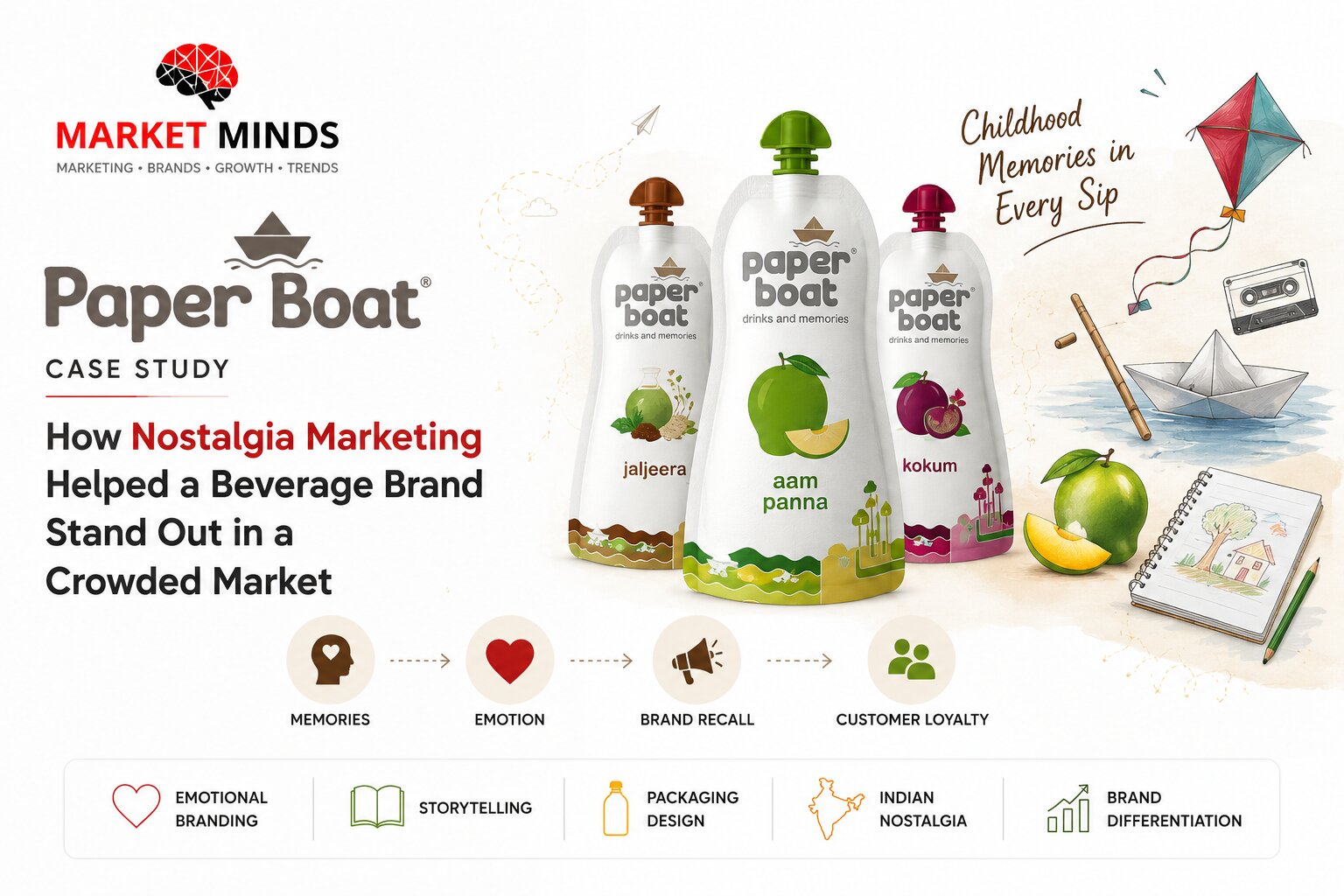
Paper Boat Case Study: How Nostalgia Marketing Helped a Beverage Brand Stand Out in a Crowded Market

AI Summary
Paper Boat is one of India’s most remarkable branding case studies because it succeeded by selling emotions instead of just beverages. In a category dominated by giants such as Coca-Cola, PepsiCo, and Parle Agro, Paper Boat differentiated itself through nostalgia, storytelling, regional flavors, and emotional branding. Rather than competing on price or product features, the brand built connections around childhood memories, Indian traditions, and cultural experiences. This case study explores how Paper Boat used nostalgia marketing, packaging design, storytelling, and product differentiation to create one of India’s most memorable FMCG brands.
Introduction
Most beverage brands sell refreshment.
Some sell energy.
Others sell taste.
Paper Boat chose a different path.
It sold memories.
In a market crowded with:
• Soft drinks
• Fruit juices
• Energy drinks
• Flavored beverages
Paper Boat managed to create a unique identity by reminding consumers of something they had almost forgotten:
Their childhood.
Through storytelling, traditional Indian flavors, emotional advertising, and distinctive packaging, Paper Boat became one of India’s strongest examples of emotional branding.
For marketers and MBA students, it offers valuable lessons in differentiation and brand building.
What is Paper Boat?
Paper Boat is a beverage brand launched by Hector Beverages.
The company focuses on traditional Indian drinks such as:
• Aam Panna
• Jaljeera
• Kokum
• Chikki Shake
• Thandai
• Neer More
• Rose Drink
Unlike conventional beverage brands, Paper Boat positioned itself around Indian memories and nostalgia.
The Challenge Paper Boat Faced
The beverage industry is one of the most competitive sectors in the world.
Major competitors include:
• Coca-Cola
• PepsiCo
• Parle Agro
• Dabur
• Regional beverage brands
Competing on:
• Distribution
• Advertising budgets
• Pricing
would have been extremely difficult.
Paper Boat needed a different strategy.
The Power of Nostalgia Marketing
Nostalgia marketing involves using memories, emotions, and familiar experiences to build emotional connections with consumers.
Why Nostalgia Works
People often associate positive emotions with:
• Childhood
• Family
• Festivals
• Simpler times
Brands that successfully trigger these memories can create stronger emotional engagement.
Paper Boat’s Insight
Consumers don’t just remember drinks.
They remember moments.
The brand built its communication around those moments.
Selling Memories Instead of Products
Traditional advertising often highlights:
• Ingredients
• Benefits
• Pricing
Paper Boat focused on:
• Childhood stories
• Family memories
• Summer vacations
• Traditional experiences
Marketing Lesson
People remember emotions more than product features.
The Role of Storytelling
Storytelling became one of Paper Boat’s most powerful branding tools.
Content Themes
Campaigns often focused on:
• School holidays
• Family gatherings
• Traditional Indian games
• Cultural experiences
Instead of saying:
“Buy this drink.”
The brand communicated:
“Remember this feeling?”
This approach created deep emotional resonance.
Product Differentiation Through Indian Flavors
Many beverage brands compete using similar flavor profiles.
Paper Boat went in the opposite direction.
Unique Products
Examples include:
• Aam Panna
• Jaljeera
• Kokum
• Golgappe-inspired drinks
• Regional beverages
These flavors were deeply familiar to Indian consumers but rarely available in modern packaged formats.
Strategic Advantage
The products themselves became part of the brand story.
Packaging as a Marketing Tool
One of the most recognizable aspects of Paper Boat is its packaging.
Why It Stands Out
Unlike traditional bottles and cans, Paper Boat introduced:
• Soft pouches
• Distinctive shapes
• Friendly design language
Consumer Impact
The packaging reinforced:
• Playfulness
• Simplicity
• Nostalgia
It became an extension of the brand identity.
Emotional Branding in Action
Paper Boat demonstrates a fundamental marketing principle:
People don’t always buy products.
They buy feelings.
Emotional Associations
The brand is associated with:
• Comfort
• Familiarity
• Tradition
• Happiness
This emotional connection creates differentiation that competitors find difficult to replicate.
Competing Without Massive Advertising Budgets
Paper Boat did not attempt to outspend industry giants.
Instead, it focused on:
• Strong positioning
• Storytelling
• Product uniqueness
• Emotional engagement
Marketing Lesson
A clear brand identity can be more powerful than a large advertising budget.
Building an Indian Brand Identity
Many brands attempt to appear global.
Paper Boat embraced being Indian.
Brand Elements
• Indian flavors
• Indian stories
• Indian memories
• Indian traditions
This authenticity helped create trust and relevance.
Challenges Facing Paper Boat in 2026
Category Competition
The beverage market continues to attract new entrants.
Consumer Trends
Health-conscious consumers increasingly seek:
• Low-sugar products
• Functional beverages
• Natural ingredients
Scaling Emotional Differentiation
As the brand grows, maintaining authenticity becomes increasingly important.
Key Marketing Lessons from Paper Boat
1. Emotions Create Differentiation
Emotional connections are difficult for competitors to copy.
2. Storytelling Builds Brands
Stories are often more memorable than product features.
3. Packaging Matters
Packaging can become a strategic branding asset.
4. Cultural Relevance Creates Loyalty
Consumers connect with brands that reflect their experiences.
5. Niche Positioning Can Beat Bigger Competitors
Strong differentiation often outperforms larger budgets.
Why MBA Students Should Study Paper Boat
Paper Boat demonstrates several important marketing concepts:
• Emotional Branding
• Nostalgia Marketing
• Storytelling
• Product Differentiation
• Packaging Strategy
• Consumer Psychology
• Brand Positioning
Few Indian brands illustrate these concepts as effectively.
Key Takeaways
• Paper Boat differentiated itself through nostalgia rather than product features.
• Storytelling became a core part of its marketing strategy.
• Traditional Indian flavors strengthened product uniqueness.
• Packaging reinforced brand identity and emotional appeal.
• Emotional branding helped the company compete against larger beverage brands.
• The brand remains one of India’s strongest examples of cultural storytelling in marketing.
Conclusion
Paper Boat’s success proves that strong brands are built on emotions, not just products. By combining nostalgia, storytelling, unique flavors, and distinctive packaging, the company created a powerful identity in one of the world’s most competitive industries. For marketers, entrepreneurs, and MBA students, Paper Boat offers valuable lessons in emotional branding, differentiation, and consumer psychology. It demonstrates that sometimes the most effective way to move forward is to help consumers reconnect with the past.
Frequently Asked Questions (FAQs)
1. Why is Paper Boat considered a strong marketing case study?
Paper Boat successfully used nostalgia marketing, storytelling, and emotional branding to differentiate itself in a crowded beverage market.
2. What is nostalgia marketing?
Nostalgia marketing uses memories and emotional experiences from the past to create stronger consumer connections.
3. How did Paper Boat differentiate its products?
Through traditional Indian flavors, unique packaging, and emotionally driven storytelling.
4. Why is storytelling important in marketing?
Stories create emotional engagement and improve brand recall.
5. What role does packaging play in branding?
Packaging influences perception, recognition, and overall brand experience.
6. What marketing lessons can businesses learn from Paper Boat?
Businesses can learn about emotional branding, differentiation, cultural relevance, and storytelling.
7. Is Paper Boat still relevant as a marketing case study in 2026?
Yes. It remains one of India’s best examples of nostalgia-driven brand building and emotional marketing.