

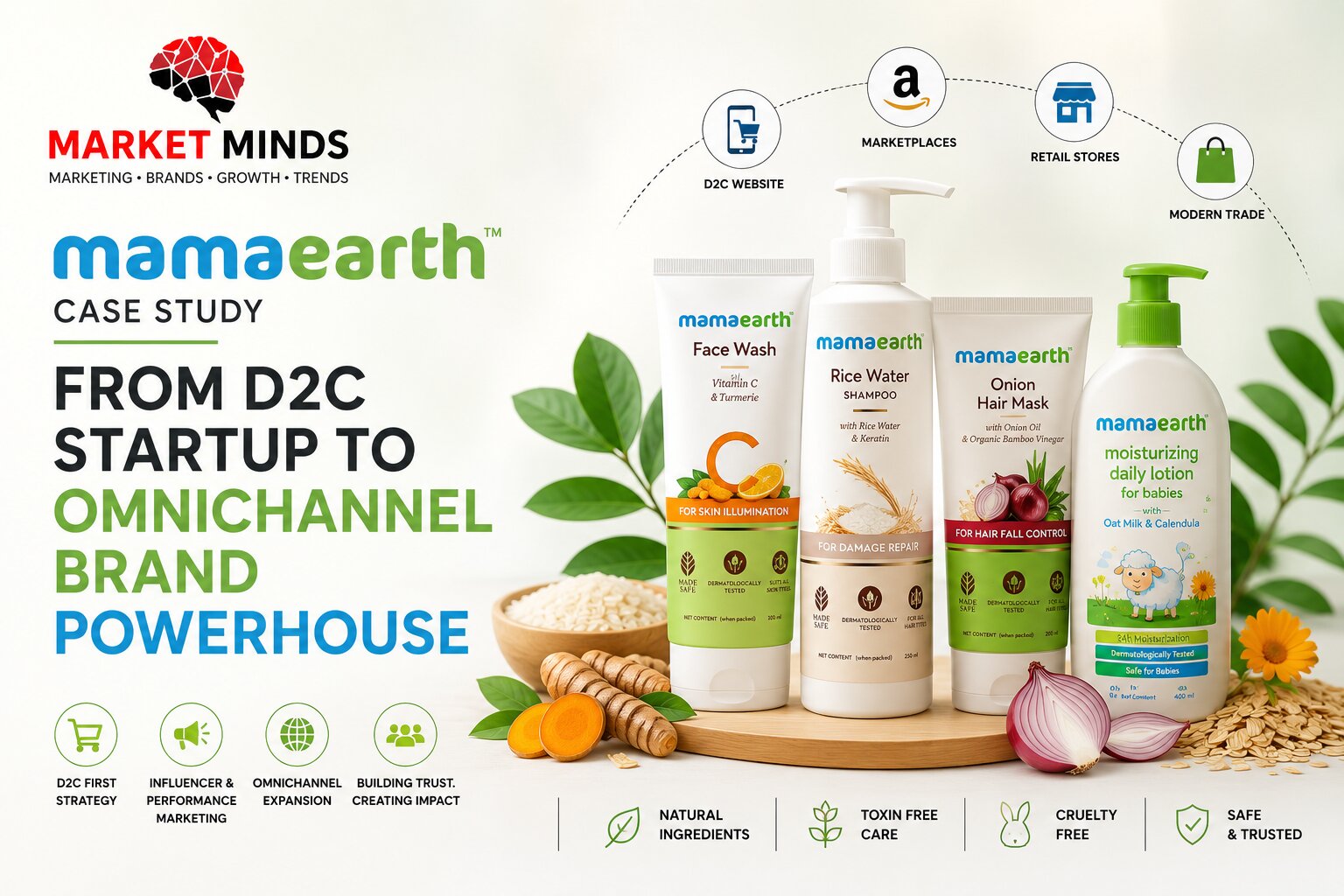
Mamaearth Case Study: From D2C Startup to Omnichannel Brand Powerhouse

AI Summary
Mamaearth is one of India’s most important D2C success stories because it demonstrates both the opportunities and challenges of digital-first brand building. The company leveraged influencer marketing, content creation, performance advertising, and purpose-driven branding to rapidly scale its customer base. However, as digital advertising costs increased, Mamaearth evolved from a pure D2C model to an omnichannel strategy involving marketplaces, modern trade, and offline retail. This case study explores Mamaearth’s growth journey, marketing strategy, customer acquisition model, IPO-driven brand evolution, and the lessons it offers to marketers and MBA students in 2026.
Introduction
A decade ago, launching a consumer brand in India required:
• Large advertising budgets
• Retail distribution networks
• Traditional media investments
• Significant manufacturing infrastructure
The rise of D2C (Direct-to-Consumer) brands changed everything.
Social media, e-commerce, and digital advertising allowed startups to build brands without relying heavily on traditional retail channels.
Among the most successful examples of this transformation is Mamaearth.
Founded in 2016, Mamaearth quickly became one of India’s fastest-growing personal care brands.
Its journey provides valuable lessons in customer acquisition, influencer marketing, brand building, and omnichannel growth.
What is Mamaearth?
Mamaearth is a personal care and beauty brand owned by Honasa Consumer Ltd.
The company offers products across categories such as:
• Skincare
• Haircare
• Baby care
• Beauty products
• Wellness products
The brand initially positioned itself around:
Safe, toxin-free, and nature-inspired products.
This positioning resonated strongly with young Indian consumers, particularly parents and millennials.
The D2C Revolution
Mamaearth emerged during a period when consumers increasingly preferred online shopping.
Unlike traditional FMCG companies, Mamaearth initially focused on:
• Direct website sales
• Digital-first marketing
• Social media engagement
• Online customer acquisition
This enabled rapid scaling without the need for extensive retail infrastructure.
The Power of Influencer Marketing
One of Mamaearth’s biggest growth drivers was influencer marketing.
Why Influencers Worked
Consumers trust people more than advertisements.
Influencers helped:
• Demonstrate products
• Build credibility
• Create awareness
• Drive purchases
The Early Advantage
At a time when many traditional brands were still experimenting with influencer marketing, Mamaearth embraced it aggressively.
This helped the brand gain visibility among digitally active consumers.
Performance Marketing as a Growth Engine
Mamaearth invested heavily in:
• Meta Ads
• Google Ads
• YouTube Advertising
• Influencer campaigns
• Affiliate marketing
The goal was simple:
Acquire customers quickly and scale aggressively.
Benefits
• Fast customer acquisition
• Precise targeting
• Measurable performance
Challenges
Over time, customer acquisition costs began rising.
This became one of the biggest challenges for many D2C brands.
The Customer Acquisition Cost (CAC) Challenge
As competition increased, digital advertising became more expensive.
Many D2C brands discovered an important lesson:
Growth does not always equal profitability.
Why CAC Matters
If acquiring a customer costs too much, profitability becomes difficult.
This forced many brands, including Mamaearth, to rethink their growth strategies.
Building Trust Through Purpose-Led Branding
Mamaearth did more than sell products.
The company positioned itself around:
• Safety
• Sustainability
• Transparency
• Environmental responsibility
Examples
Campaigns focused on:
• Plastic recycling
• Tree plantation initiatives
• Ingredient transparency
This helped create emotional connections with customers.
Why D2C Alone Was Not Enough
One of the most important lessons from Mamaearth’s journey is that online growth has limitations.
Consumers increasingly wanted:
• Product trials
• Offline availability
• Retail convenience
• Faster access
As a result, the company expanded beyond pure D2C.
The Omnichannel Transformation
Mamaearth gradually expanded into:
Marketplaces
• Amazon
• Flipkart
• Nykaa
Modern Trade
• Reliance Retail
• Health & Glow
• Beauty chains
General Trade
Traditional retail stores across India.
Why This Matters
Customers can now discover products through:
Instagram → Website → Marketplace → Retail Store
The journey is no longer limited to one channel.
The IPO Effect
Mamaearth’s IPO significantly increased visibility.
Benefits
• Brand credibility
• Investor confidence
• Media attention
• Consumer awareness
The company evolved from a startup success story into a publicly recognized brand.
Competition in 2026
Mamaearth competes against:
Traditional FMCG Players
• HUL
• ITC
• Dabur
• Himalaya
D2C Brands
• Minimalist
• The Derma Co.
• Plum
• Wow Skin Science
• Aqualogica
Competition has intensified significantly.
Key Marketing Lessons from Mamaearth
1. Speed Matters
Digital-first brands can scale rapidly through online channels.
2. Influencers Drive Discovery
Creator partnerships can accelerate trust and awareness.
3. Customer Acquisition Must Be Sustainable
Growth without profitability is difficult to sustain.
4. Trust Is a Competitive Advantage
Consumers increasingly reward transparent brands.
5. Omnichannel Wins
Modern consumers expect brands to be available everywhere.
Why MBA Students Should Study Mamaearth
Mamaearth combines multiple modern marketing concepts:
• D2C Growth
• Influencer Marketing
• Performance Marketing
• Omnichannel Strategy
• Brand Positioning
• IPO Branding
• Customer Acquisition Economics
Few Indian brands provide such a comprehensive modern marketing case study.
Key Takeaways
• Mamaearth successfully leveraged D2C and influencer marketing for rapid growth.
• Rising customer acquisition costs highlighted the limitations of digital-only growth.
• Omnichannel expansion became essential for long-term scalability.
• Trust and transparency helped strengthen brand positioning.
• The company demonstrates both the strengths and challenges of modern D2C marketing.
Conclusion
Mamaearth’s journey reflects the evolution of India’s D2C ecosystem. The company proved that digital-first brands can disrupt traditional industries through smart marketing, influencer partnerships, and customer-centric positioning. At the same time, it highlighted the importance of profitability, customer acquisition efficiency, and omnichannel distribution. For marketers, entrepreneurs, and MBA students, Mamaearth remains one of India’s most relevant business case studies in understanding how modern consumer brands scale and mature.
Frequently Asked Questions (FAQs)
1. Why is Mamaearth considered a successful D2C brand?
Mamaearth leveraged digital marketing, influencer partnerships, and strong brand positioning to rapidly acquire customers and scale.
2. What role did influencer marketing play in Mamaearth’s growth?
Influencers helped build awareness, trust, and product discovery among digital-first consumers.
3. Why did Mamaearth move beyond D2C?
The company recognized that long-term growth required offline retail presence and broader distribution.
4. What is omnichannel retail?
Omnichannel retail integrates online and offline customer experiences across multiple channels.
5. What challenges do D2C brands face?
Rising customer acquisition costs, increasing competition, and profitability pressures are common challenges.
6. How did Mamaearth build trust with consumers?
Through transparency, safe product positioning, sustainability initiatives, and consistent communication.
7. What marketing lessons can businesses learn from Mamaearth?
Businesses can learn about D2C growth, influencer marketing, customer acquisition, trust-building, and omnichannel expansion.