

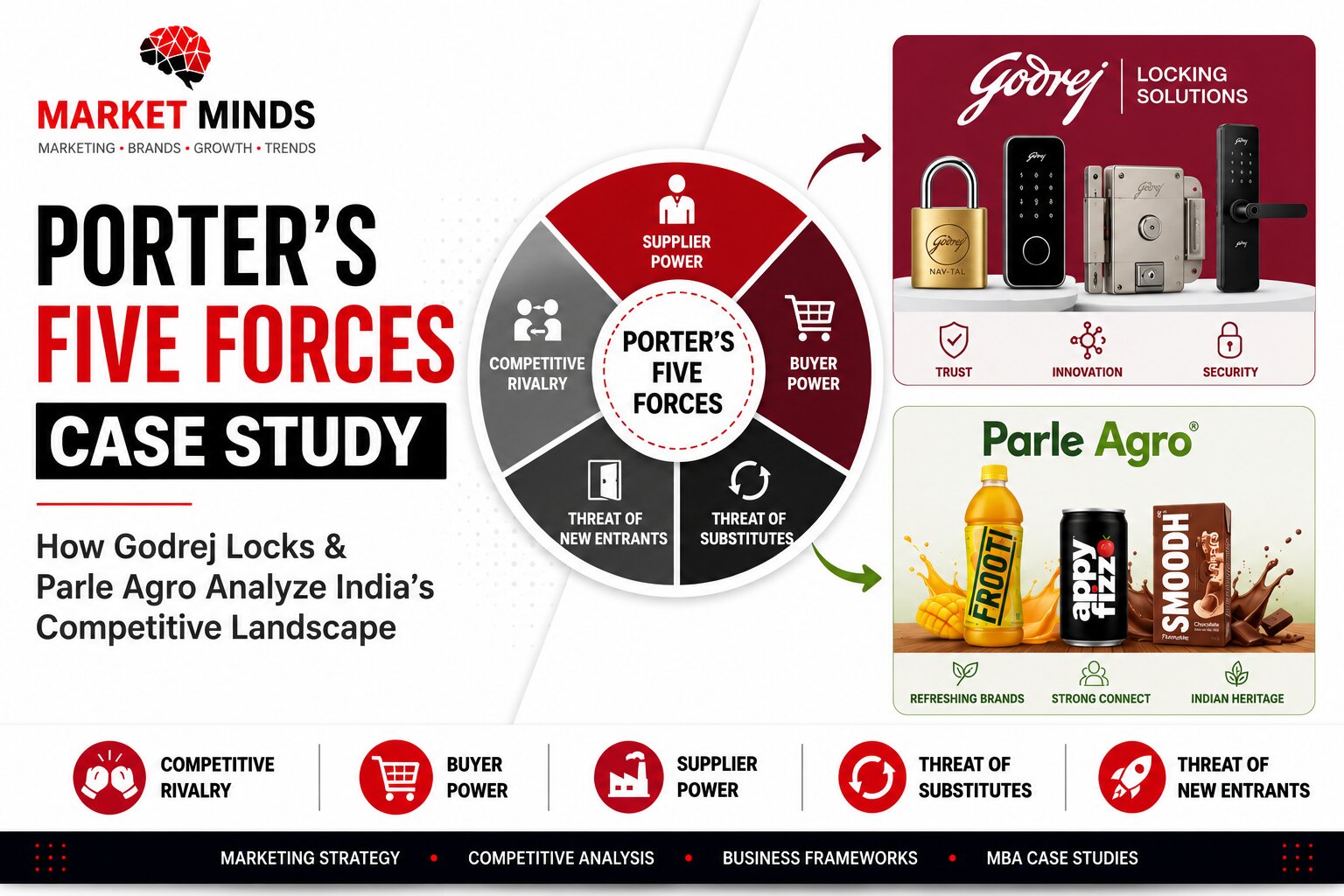
Porter’s Five Forces Explained: How Godrej Locks & Parle Agro Analyze India’s Competitive Landscape

AI Summary
Porter’s Five Forces is one of the most widely used business frameworks for analyzing industry competitiveness and profitability. Developed by Michael Porter, the model helps businesses understand how market forces influence their long-term success. In India’s rapidly evolving economy, companies such as Godrej and Parle Agro continuously evaluate supplier power, buyer power, competitive rivalry, substitutes, and new entrants to maintain their market position. This article explains Porter’s Five Forces framework using real-world examples from India’s manufacturing and FMCG sectors, making it easier for students, marketers, and business professionals to understand strategic decision-making.
Introduction
Why do some industries consistently generate strong profits while others struggle despite high demand?
Why do market leaders continue investing heavily in innovation even after becoming dominant players?
The answer often lies in understanding competition.
Businesses do not operate in isolation. They compete against rivals, negotiate with suppliers, respond to customers, defend against substitutes, and prepare for new entrants.
To analyze these forces, Harvard professor Michael Porter introduced one of the most influential strategic frameworks in business history: Porter’s Five Forces Model.
Today, this framework remains a core part of MBA programs, corporate strategy discussions, and business planning exercises worldwide.
In this article, we’ll understand Porter’s Five Forces through the lens of two iconic Indian companies: Godrej and Parle Agro.
What is Porter’s Five Forces Model?
Porter’s Five Forces is a strategic framework used to analyze the attractiveness and profitability of an industry.
The model evaluates five competitive forces:
- Competitive Rivalry
- Threat of New Entrants
- Threat of Substitutes
- Bargaining Power of Buyers
- Bargaining Power of Suppliers
Together, these forces determine how competitive an industry is and how profitable businesses can be over the long term.
Force 1: Competitive Rivalry
This force measures the intensity of competition among existing players.
Higher competition often leads to:
• Price wars
• Increased marketing spending
• Reduced profitability
• Continuous innovation
Example: Parle Agro
Parle Agro operates in one of India’s most competitive FMCG categories.
Its brands such as:
• Frooti
• Appy Fizz
• Smoodh
compete against:
• Coca-Cola
• PepsiCo
• Dabur
• Paper Boat
• Regional beverage brands
Competition extends beyond pricing and includes:
• Distribution reach
• Product innovation
• Advertising
• Retail shelf space
• Celebrity endorsements
As a result, competitive rivalry remains extremely high.
Example: Godrej Security Solutions
Godrej competes against:
• Europa
• Yale
• Dorset
• Hafele
• Digital lock manufacturers
The growing adoption of smart homes has intensified competition, requiring continuous innovation in security technology.
Verdict
Competitive Rivalry:
• Parle Agro – Very High
• Godrej Security Solutions – Moderate to High
Force 2: Threat of New Entrants
This force evaluates how easily new competitors can enter the market.
Industries with low entry barriers attract more competitors, increasing competitive pressure.
Example: Parle Agro
Entering India’s beverage industry requires:
• Manufacturing infrastructure
• Distribution networks
• Retail relationships
• Regulatory approvals
• Marketing investments
Building nationwide distribution is particularly difficult.
This creates a strong barrier against new entrants.
Example: Godrej
Godrej benefits from:
• Strong brand trust
• Dealer networks
• Manufacturing expertise
• Long-standing customer relationships
Although new smart lock startups are emerging, building consumer trust remains challenging.
Verdict
Threat of New Entrants:
• Parle Agro – Low
• Godrej – Low to Moderate
Force 3: Threat of Substitutes
Substitutes are alternative products that satisfy the same customer need.
A high threat of substitutes can limit pricing power and profitability.
Example: Parle Agro
Consumers seeking refreshment can choose:
• Soft drinks
• Packaged juices
• Coconut water
• Energy drinks
• Tea
• Coffee
• Flavored milk
Because alternatives are abundant, substitutes pose a significant threat.
Example: Godrej
Customers seeking security can choose:
• Traditional locks
• Smart locks
• Security systems
• Access control solutions
• Digital surveillance products
As technology evolves, traditional lock manufacturers face increasing substitute pressure.
Verdict
Threat of Substitutes:
• Parle Agro – High
• Godrej – Moderate
Force 4: Bargaining Power of Buyers
This force measures how much influence customers have over pricing and business decisions.
When buyers have many alternatives, their bargaining power increases.
Example: Parle Agro
Consumers have numerous beverage choices.
Retailers also possess significant influence because shelf placement directly impacts sales.
Large modern trade retailers often negotiate aggressively with manufacturers.
Example: Godrej
Customers evaluating security solutions can compare multiple brands online.
However, Godrej’s strong reputation reduces buyer bargaining power to some extent.
Brand trust remains an important competitive advantage.
Verdict
Buyer Power:
• Parle Agro – High
• Godrej – Moderate
Force 5: Bargaining Power of Suppliers
Suppliers can influence costs, quality, and production capabilities.
Industries dependent on specialized suppliers often face greater supplier power.
Example: Parle Agro
Key inputs include:
• Fruit concentrates
• Packaging materials
• Sugar
• Manufacturing inputs
Because Parle Agro operates at scale and sources from multiple vendors, supplier power remains relatively controlled.
Example: Godrej
Smart lock products increasingly require:
• Electronic components
• Sensors
• Microchips
• Technology modules
Global semiconductor supply disruptions can affect production costs and timelines.
Therefore supplier power is slightly higher in technology-driven categories.
Verdict
Supplier Power:
• Parle Agro – Low to Moderate
• Godrej – Moderate
Porter’s Five Forces Summary Table
| Force | Parle Agro | Godrej Security Solutions |
| Competitive Rivalry | High | Moderate to High |
| Threat of New Entrants | Low | Low to Moderate |
| Threat of Substitutes | High | Moderate |
| Buyer Power | High | Moderate |
| Supplier Power | Low to Moderate | Moderate |
Why Porter’s Five Forces Still Matters in 2026
Despite the rise of AI, digital transformation, and platform-based business models, the fundamentals of competition remain unchanged.
Porter’s framework helps businesses:
• Identify industry risks
• Understand competitive dynamics
• Evaluate market attractiveness
• Develop growth strategies
• Make investment decisions
Whether you’re analyzing FMCG, e-commerce, fintech, manufacturing, or technology sectors, the framework remains highly relevant.
Key Takeaways
• Porter’s Five Forces helps businesses understand industry competition and profitability.
• Parle Agro faces intense rivalry and substitute threats due to India’s highly competitive beverage market.
• Godrej benefits from strong brand trust but faces increasing pressure from smart security technologies.
• Barriers to entry protect both companies from new competitors.
• Understanding competitive forces helps organizations make better strategic decisions.
Conclusion
Porter’s Five Forces remains one of the most powerful frameworks for understanding business competition. By examining factors such as rivalry, substitutes, buyer power, supplier power, and entry barriers, companies can identify opportunities and threats within their industries. The experiences of Godrej and Parle Agro demonstrate how even market-leading brands must continuously adapt to changing competitive dynamics. For students, marketers, and business leaders, mastering Porter’s Five Forces provides valuable insights into how successful companies sustain their advantage in an increasingly competitive marketplace.
Frequently Asked Questions (FAQs)
1. What is Porter’s Five Forces Model?
Porter’s Five Forces is a strategic framework used to analyze the competitive intensity and profitability of an industry.
2. Who developed Porter’s Five Forces?
The framework was developed by Harvard Business School professor Michael Porter in 1979.
3. Why is Porter’s Five Forces important?
It helps businesses understand industry competition, identify threats, and develop effective growth strategies.
4. Is Porter’s Five Forces still relevant in 2026?
Yes. It remains one of the most widely used strategic analysis frameworks across industries worldwide.
5. How does Parle Agro face competitive rivalry?
Parle Agro competes against major beverage brands such as Coca-Cola, PepsiCo, Dabur, and several emerging beverage companies.
6. What are substitutes in Porter’s Five Forces?
Substitutes are alternative products or services that satisfy the same customer need.
7. Can startups use Porter’s Five Forces?
Absolutely. Startups can use the framework to evaluate market attractiveness before entering an industry.