

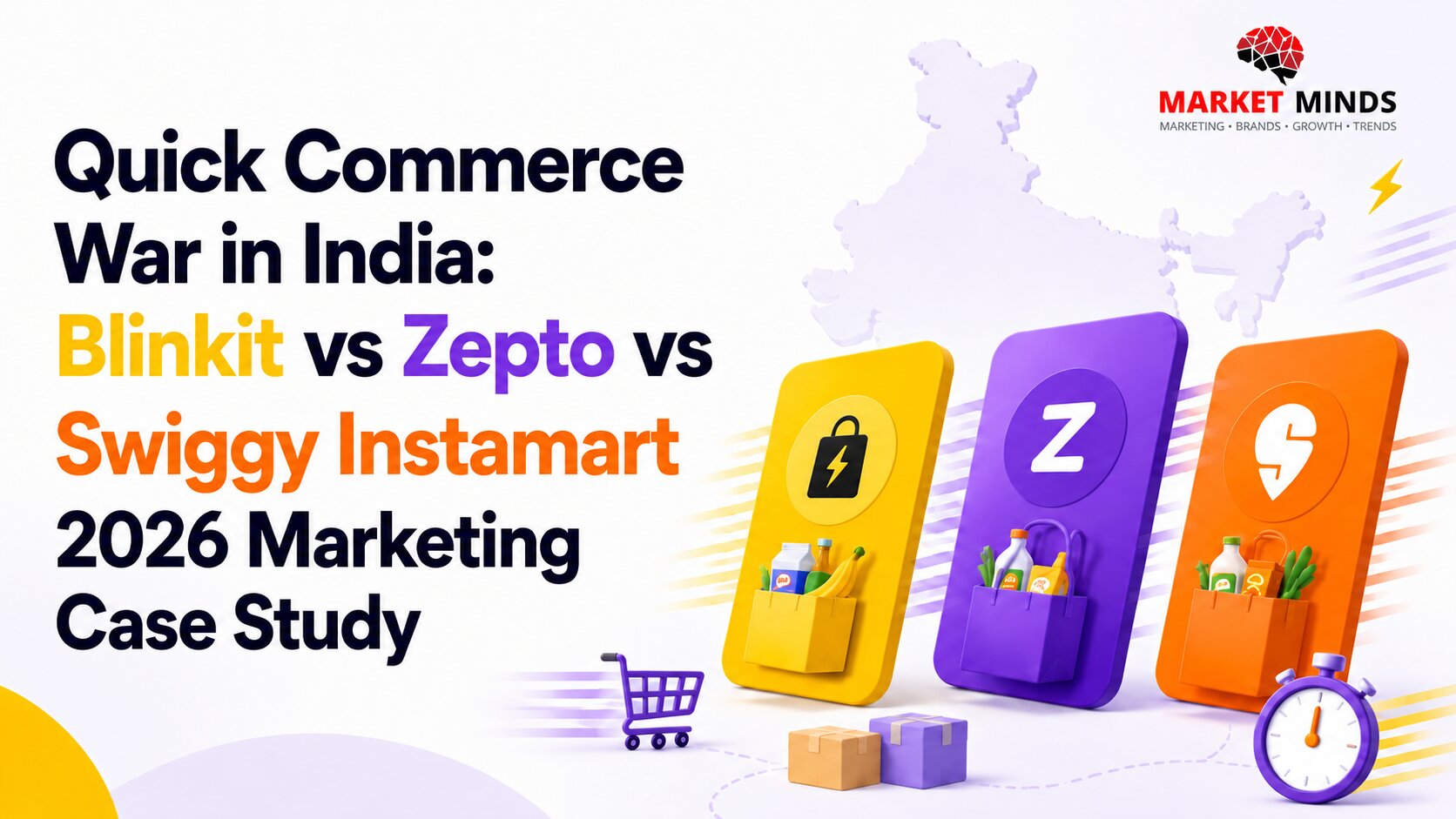
Quick Commerce War in India: Blinkit vs Zepto vs Swiggy Instamart Case Study 2026

AI Summary
Quick commerce in India has moved far beyond groceries. In 2026, Blinkit, Zepto and Swiggy Instamart are fighting for consumer habit, not just market share. Blinkit currently looks strongest because of scale, dark store density, stronger integration with the Zomato/Eternal ecosystem and improving profitability signals. Zepto remains the bold challenger with aggressive expansion, youth appeal, strong funding and IPO ambitions. Swiggy Instamart has the advantage of Swiggy’s food delivery ecosystem, but it is under pressure to balance growth with profitability. The real marketing lesson is simple: in modern India, speed is no longer just a service feature. It has become a brand promise, a distribution strategy and a consumer behavior shift.
Introduction: The New Battle for Indian Consumers
A few years ago, grocery shopping in India meant visiting a nearby kirana store, ordering monthly supplies from a supermarket, or waiting for an e-commerce delivery. Today, many urban consumers expect milk, chips, fruits, cosmetics, chargers, stationery and even festive items to arrive within minutes.
That shift has created one of India’s most exciting marketing battles: Blinkit vs Zepto vs Swiggy Instamart.
As of 2026, quick commerce is no longer a small convenience category. Reuters reported that India’s quick commerce market was valued at around ₹640 billion, or about $7.28 billion, in FY2025, and CareEdge projected that it could triple by 2028.
This is not just a startup story. It is a full marketing case study on speed, habit formation, consumer psychology, category expansion, pricing, dark-store distribution and brand positioning.
What Is Quick Commerce?
Quick commerce, or q-commerce, is the model of delivering products to customers extremely fast, usually through nearby dark stores. These dark stores are small fulfillment centers placed close to high-demand localities.
Unlike traditional e-commerce, quick commerce does not depend only on huge warehouses and long delivery timelines. Its success depends on location density, accurate demand forecasting, product assortment, delivery partner availability and high repeat usage.
In simple words, quick commerce wins when it becomes a daily habit.
Why This Case Study Matters in 2026
The quick commerce battle matters because it shows how Indian consumers are changing.
Earlier, consumers compared price, brand and quality. Now they also compare speed, availability and convenience. If one app can deliver a product in 10 to 20 minutes, the customer may not wait one or two days for an e-commerce order.
This has affected FMCG brands, D2C brands, grocery retailers, kirana stores, e-commerce platforms and even offline modern retail. In December 2025, Inc42 reported that analysts expected quick commerce players to add nearly 2,000 to 2,500 new dark stores in 2026 across metros, Tier 1 suburbs and high-income micro-markets.
That means the battle is not only about apps. It is about who controls the consumer’s most frequent purchase moments.
Blinkit: The Scale Leader
Blinkit has become the strongest player in India’s quick commerce conversation. Its biggest advantage is its integration with Zomato, now under Eternal Limited. The company benefits from Zomato’s consumer base, data, delivery understanding, brand trust and capital access.
Blinkit’s marketing strength lies in its clarity. It is not trying to be only a grocery app. It is becoming an instant commerce platform. Consumers now use Blinkit for food ingredients, snacks, personal care, electronics accessories, stationery, medicines in select areas, gifting products and festive items.
Reuters reported in January 2025 that Blinkit held a 46 percent share in India’s quick commerce space, while competing with Swiggy Instamart, Zepto, Flipkart and BigBasket.
By 2026, Blinkit’s position became even stronger in public market discussions. The Arc reported that Blinkit posted an adjusted EBITDA profit of ₹37 crore for Q4 FY26 and opened 216 new dark stores during the quarter.
From a marketing point of view, Blinkit’s biggest strength is frequency. If a consumer opens Blinkit several times a week, the brand becomes a habit, not just an app.
Zepto: The Aggressive Challenger
Zepto built its brand around speed, youthfulness and ambition. It entered the market with a sharp promise: ultra-fast delivery. The brand has always looked more startup-like, bold and youth-centric compared to older platforms.
Zepto’s marketing appeal comes from three areas: speed, freshness and urban relevance. It has strong recall among younger consumers, especially in metro cities. It also pushed hard into categories beyond basic groceries.
Reuters reported in October 2025 that Zepto raised $450 million at a $7 billion valuation. The report also noted that Zepto offered more than 45,000 products including electronics and apparel, and had relocated from Singapore to India in January 2025 in preparation for a public listing.
In 2026, Zepto’s IPO story made it even more relevant. Economic Times reported that Zepto’s unlisted shares fell around 30 percent over a month even after receiving SEBI approval for its IPO, showing investor caution around valuation and profitability.
That makes Zepto a very interesting MBA marketing case. It has strong brand energy and growth, but it must prove whether aggressive expansion can eventually convert into sustainable profitability.
Swiggy Instamart: The Ecosystem Player Under Pressure
Swiggy Instamart has a major advantage: it is part of the Swiggy ecosystem. Swiggy already has strong consumer behavior data, food delivery frequency, delivery infrastructure and app recall.
This gives Instamart a natural cross-selling advantage. A customer ordering dinner from Swiggy can also be encouraged to order groceries, snacks, beverages or essentials from Instamart.
Swiggy’s Q4 FY26 shareholder letter reported that food delivery GOV grew 22.6 percent year-on-year to ₹9,005 crore in Q4 FY26. The company also reported strong momentum in Instamart, though the quick commerce business remained investment-heavy.
According to public commentary from Swiggy leadership, the quick commerce market may not sustain as many players as it has today, because competition is intense and capital requirements are high.
That is the central challenge for Swiggy Instamart: it has the ecosystem, but it must balance market share growth, dark store expansion, delivery cost and profitability.
Marketing Comparison: Blinkit vs Zepto vs Swiggy Instamart
1. Positioning
Blinkit positions itself as the reliable, everyday instant delivery platform.
Zepto positions itself as the fast, young and aggressive quick commerce brand.
Swiggy Instamart positions itself as a convenience extension of the Swiggy ecosystem.
Marketing lesson: Blinkit owns reliability, Zepto owns speed perception, and Instamart owns ecosystem convenience.
2. Target Audience
Blinkit appeals strongly to urban families, working professionals, young couples and high-frequency grocery buyers.
Zepto appeals strongly to students, young professionals, Gen Z consumers and impulse buyers.
Swiggy Instamart appeals to existing Swiggy food delivery users who want groceries and essentials from the same app.
Marketing lesson: The same category can have different customer psychology depending on brand positioning.
3. Distribution Strategy
The real backbone of quick commerce is not advertising. It is the dark store network.
Blinkit’s scale and dense network give it an edge in availability and delivery speed. Zepto is expanding aggressively and has built a strong urban presence. Swiggy Instamart has logistics experience, but must keep improving store density and assortment depth.
Inc42 reported that 2026 would be a year of hyper growth for quick commerce, with dark-store expansion becoming a key factor in deciding the winner.
Marketing lesson: In quick commerce, distribution itself becomes a marketing advantage.
4. Assortment Strategy
Earlier, quick commerce was mostly about groceries and daily essentials. Now the category includes beauty products, electronics accessories, gifting items, toys, stationery, home products and festival products.
This is important because higher value products can improve average order value. Swiggy’s Q4 FY26 commentary noted that Instamart’s average order value grew 33 percent year-on-year to ₹700, supported by non-grocery mix and larger basket behavior.
Marketing lesson: Quick commerce is slowly moving from emergency buying to planned convenience buying.
5. Pricing and Discounts
Quick commerce initially grew with discounts, coupons and free delivery. But in 2026, the industry is being forced to move toward profitability.
Blinkit appears to be moving faster toward operating leverage. Zepto is under investor pressure to prove profitability before or around IPO. Swiggy Instamart is also working toward contribution margin improvement.
Marketing lesson: Discounts can create trial, but they cannot build a sustainable brand alone.
6. Consumer Psychology
The biggest success of quick commerce is not only fast delivery. It is the reduction of mental effort.
Consumers do not need to plan everything in advance. They can order whenever they remember something. This creates impulse buying and repeat app usage.
This is why quick commerce is dangerous for traditional retail. It attacks the small everyday moments: “I need milk,” “I need chips,” “I forgot toothpaste,” “guests are coming,” “I need a charger now.”
Marketing lesson: The most powerful brands are often the ones that reduce friction in daily life.
7. Brand Communication
Blinkit’s communication is often simple, witty and occasion-led. It focuses on moments of need.
Zepto’s communication is sharper, younger and more performance-led. It focuses on speed, freshness and urban lifestyle.
Swiggy Instamart benefits from Swiggy’s existing brand personality: convenience, food, humor and app familiarity.
Marketing lesson: In a low-attention digital market, relatable moment marketing works better than generic brand campaigns.
8. The Regulatory and Social Challenge
Quick commerce also faces concerns around rider safety, wages, road discipline and the pressure created by ultra-fast delivery promises.
Reuters reported in January 2026 that major quick commerce players including Flipkart, Swiggy, Zepto and Blinkit dropped or changed “10-minute delivery” claims after government concerns around road safety and worker conditions.
This is important for marketing students because it shows that a brand promise can also become a reputational risk.
Marketing lesson: A strong promise must be operationally and socially responsible.
Who Is Winning in 2026?
Based on current public signals, Blinkit appears to be leading the quick commerce race in India. It has strong scale, higher visibility, a dense dark store network, support from Eternal/Zomato and improving profitability indicators.
Zepto is the strongest challenger. It has youth appeal, funding, speed-led positioning and IPO momentum, but profitability will be closely watched.
Swiggy Instamart remains a serious player because of Swiggy’s ecosystem, but it faces pressure from Blinkit’s scale and Zepto’s aggressive brand energy.
However, the final winner may not be decided only by market share. The real winner will be the company that can balance five things:
- Fast delivery
- Product availability
- Strong unit economics
- Customer loyalty
- Responsible operations
Key Marketing Lessons from Blinkit vs Zepto vs Swiggy Instamart
The first lesson is that speed can become a brand asset. Delivery time is no longer just an operational metric. It is part of the customer’s perception of the brand.
The second lesson is that distribution can beat advertising. A brand with more dark stores, better availability and faster fulfillment can win even before the customer sees an ad.
The third lesson is that habit is more powerful than awareness. Quick commerce apps want to become part of daily life. Once that habit forms, retention becomes easier.
The fourth lesson is that category expansion increases revenue potential. Grocery alone may not be enough. Electronics, beauty, personal care, gifting and premium products can increase average order value.
The fifth lesson is that profitability is the real test. Growth without a path to profit is becoming harder to defend in 2026.
Conclusion
Blinkit vs Zepto vs Swiggy Instamart is one of the best modern marketing case studies in India. It covers almost everything a marketing student or business professional should understand: consumer behavior, brand positioning, pricing, distribution, retention, digital marketing, category expansion and profitability.
In 2026, quick commerce is not just about who delivers fastest. It is about who understands the Indian consumer best.
Blinkit has the current leadership advantage. Zepto has challenger energy. Swiggy Instamart has ecosystem strength.
But the final winner will be the platform that can turn speed into trust, convenience into habit, and growth into profit.
FAQs
1. Which is better: Blinkit, Zepto or Swiggy Instamart?
In 2026, Blinkit appears to be the strongest overall player because of scale, market leadership, dark store density and improving profitability signals. Zepto is a strong challenger among younger consumers, while Swiggy Instamart benefits from Swiggy’s food delivery ecosystem.
2. Why is Blinkit leading quick commerce in India?
Blinkit is leading because it has strong brand recall, wide assortment, dense dark store coverage, integration with Zomato/Eternal and strong consumer frequency. Its ability to move beyond groceries has also helped it become an everyday convenience app.
3. Is Zepto profitable in 2026?
Zepto has shown strong growth and has raised large funding, but profitability remains a key concern for investors. Its IPO story has made the company highly visible, but the market is watching whether it can reduce losses while maintaining growth.
4. What is Swiggy Instamart’s biggest advantage?
Swiggy Instamart’s biggest advantage is the Swiggy ecosystem. It can cross-sell to existing food delivery users and use Swiggy’s logistics knowledge, app traffic and customer data to grow quick commerce.
5. What is the biggest marketing lesson from quick commerce?
The biggest lesson is that convenience can change consumer behavior. When customers get used to instant delivery, speed becomes an expectation, not a luxury. This changes how brands think about distribution, pricing, product visibility and customer retention.