
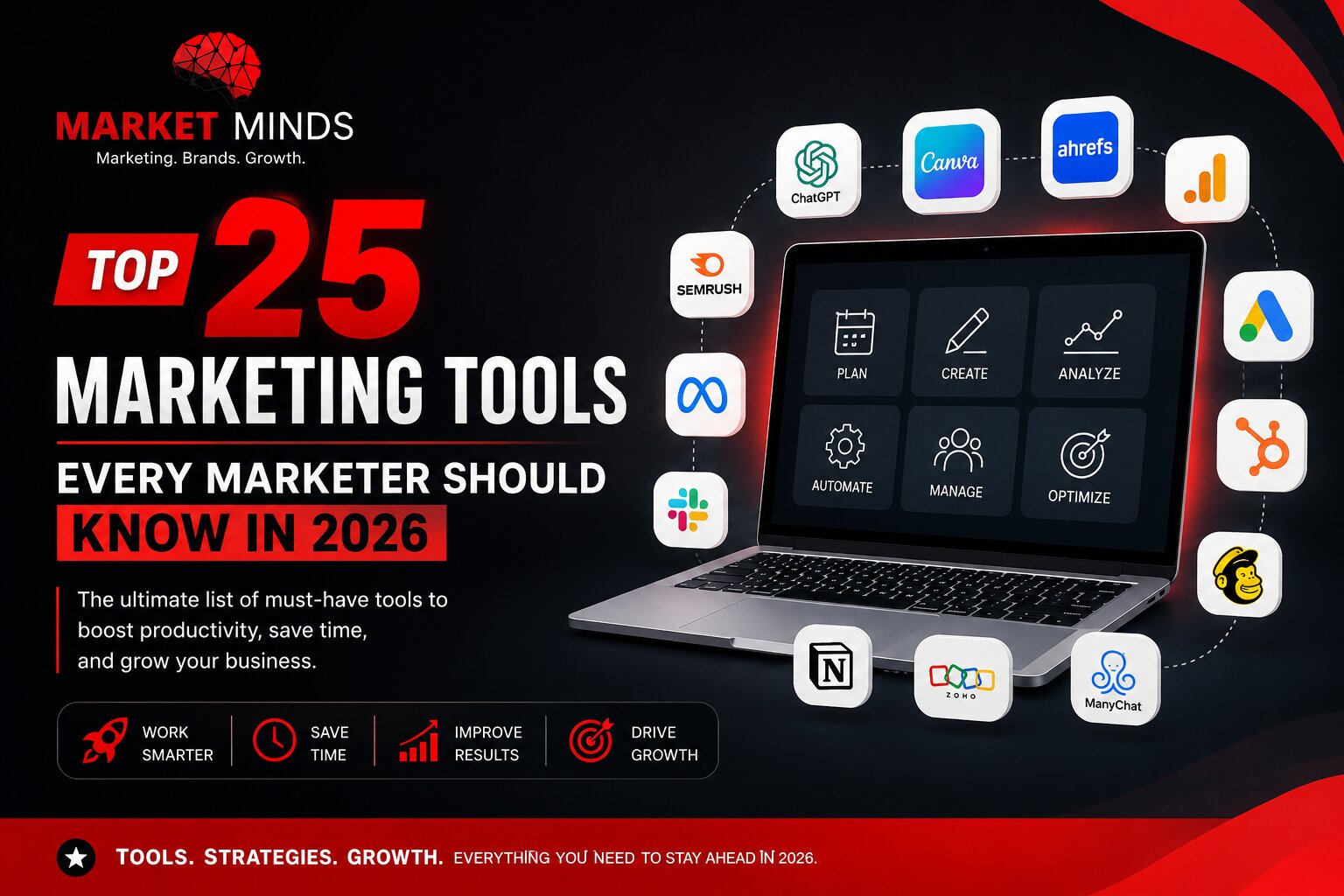
Top 25 Marketing Tools Every Marketer Should Know in 2026

AI Summary
Marketing in 2026 is driven by automation, AI, analytics, content, and customer experience. This article explores 25 essential marketing tools across categories such as SEO, social media, content creation, email marketing, CRM, analytics, design, and AI. Whether you’re a student, freelancer, entrepreneur, or marketing professional, these tools can help improve productivity, streamline workflows, and deliver better marketing results. Understanding and mastering the right tools is becoming just as important as learning marketing itself.
Marketing in 2026 is no longer about working harder. It is about working smarter.
The modern marketer is expected to manage content creation, social media, SEO, paid advertising, analytics, automation, CRM, and customer engagement simultaneously. Fortunately, the right set of tools can help marketers achieve more with less time and effort.
Whether you are a student, freelancer, startup founder, agency professional, or marketing manager, these are the 25 marketing tools every marketer should know in 2026.
AI & Content Creation Tools
1. ChatGPT
Best for: Content creation, brainstorming, strategy development, customer support, research, and workflow automation.
ChatGPT has become an essential assistant for marketers. From generating blog outlines and social media captions to creating ad copies and marketing plans, it significantly improves productivity.
2. Claude
Best for: Long-form content and document analysis.
Claude excels at handling lengthy documents, reports, and detailed content projects. It is particularly useful for marketers working on research-heavy content.
3. Perplexity AI
Best for: Research and fact-checking.
Instead of searching multiple websites, marketers can use Perplexity to quickly gather reliable information and sources.
4. Jasper AI
Best for: Marketing copywriting.
Jasper is designed specifically for marketers who need high-quality ad copy, email campaigns, landing pages, and sales content.
SEO & Content Marketing Tools
5. Ahrefs
Best for: Backlink analysis and keyword research.
Ahrefs remains one of the most powerful SEO platforms available. It helps marketers discover keyword opportunities and monitor competitors.
6. Semrush
Best for: Complete SEO management.
Semrush provides keyword research, content optimization, site audits, competitor analysis, and paid advertising insights in one platform.
7. Google Search Console
Best for: Website performance monitoring.
Every marketer should use Search Console to track keyword rankings, indexing issues, click-through rates, and search visibility.
8. Screaming Frog
Best for: Technical SEO audits.
This tool scans websites to identify broken links, duplicate content, crawl errors, and other SEO issues.
Analytics & Data Tools
9. Google Analytics 4 (GA4)
Best for: Website traffic analysis.
GA4 helps marketers understand how users interact with websites and where conversions are coming from.
10. Microsoft Clarity
Best for: User behavior analysis.
Clarity provides heatmaps and session recordings that reveal exactly how visitors interact with a website.
11. Looker Studio
Best for: Marketing dashboards.
It allows marketers to combine data from multiple sources and create visually appealing reports for stakeholders.
Social Media Marketing Tools
12. Buffer
Best for: Social media scheduling.
Buffer helps marketers plan, schedule, and analyze social media content efficiently.
13. Hootsuite
Best for: Enterprise social media management.
Large organizations use Hootsuite to manage multiple social accounts from one dashboard.
14. Metricool
Best for: Social media analytics.
Metricool combines content scheduling with performance tracking, making it a favorite among agencies.
Design & Creative Tools
15. Canva
Best for: Graphic design.
Canva has transformed content creation by enabling non-designers to create professional visuals quickly.
16. Adobe Express
Best for: Quick creative production.
Ideal for marketers who need branded graphics, videos, and social media assets without complex design software.
17. Figma
Best for: Collaborative design.
Figma is widely used for UI/UX design, website wireframes, and collaborative creative projects.
Video Marketing Tools
18. CapCut
Best for: Short-form video editing.
CapCut has become one of the most popular tools for creating Instagram Reels, TikTok videos, and YouTube Shorts.
19. Descript
Best for: AI-powered video editing.
Descript allows users to edit videos by editing text transcripts, saving significant production time.
20. VEED.IO
Best for: Online video creation.
Perfect for adding subtitles, captions, voiceovers, and quick edits without advanced software.
CRM & Automation Tools
21. HubSpot
Best for: Marketing automation and CRM.
HubSpot helps businesses manage leads, automate campaigns, and track customer journeys.
22. Zoho CRM
Best for: Lead management.
A powerful and cost-effective CRM solution for small and medium-sized businesses.
23. ManyChat
Best for: Chat automation.
ManyChat helps businesses automate conversations on Instagram, Facebook Messenger, and WhatsApp.
Paid Advertising Tools
24. Meta Ads Manager
Best for: Facebook and Instagram advertising.
Meta Ads Manager remains one of the most powerful advertising platforms for lead generation and brand awareness.
25. Google Ads
Best for: Search and display advertising.
Google Ads enables businesses to reach customers actively searching for products and services.
Which Marketing Tools Should Beginners Start With?
If you are just beginning your marketing journey, start with these seven tools:
• ChatGPT
• Canva
• Google Analytics 4
• Google Search Console
• Meta Ads Manager
• CapCut
• Zoho CRM
These tools cover content creation, design, analytics, advertising, video editing, and lead management.
Final Thoughts
Technology continues to reshape the marketing industry. The most successful marketers in 2026 are not necessarily those who work the hardest but those who leverage the right tools effectively.
You do not need all 25 tools immediately. Start with the essentials, master them, and gradually expand your toolkit as your marketing responsibilities grow.
The future belongs to marketers who combine creativity, data, automation, and AI. These 25 tools provide a strong foundation for building that future.
Frequently Asked Questions (FAQs)
1. What are the most important marketing tools to learn in 2026?
AI tools, SEO platforms, analytics software, CRM systems, email marketing tools, and social media management platforms are among the most important tools marketers should learn in 2026.
2. Do I need to learn all 25 marketing tools to become a successful marketer?
No. The best approach is to start with tools relevant to your role and gradually expand your toolkit as your responsibilities and expertise grow.
3. Which marketing tools are best for beginners?
Tools like Canva, ChatGPT, Google Analytics, Google Search Console, Mailchimp, and Buffer are beginner-friendly and widely used across the industry.
4. How are AI tools changing marketing in 2026?
AI tools help marketers create content, automate repetitive tasks, analyze customer behavior, optimize campaigns, and improve productivity, making them an essential part of modern marketing.
5. Are free marketing tools sufficient for learning and small businesses?
Yes. Many leading platforms offer free versions that are powerful enough for learning, personal projects, and small business marketing activities.
6. Which marketing tool is best for SEO?
Popular SEO tools include Ahrefs, Semrush, Google Search Console, Screaming Frog, and Surfer SEO. The right choice depends on your budget and specific SEO needs.
7. How often should marketers update their marketing tool stack?
Marketers should review and update their tool stack at least once a year, as new AI-powered platforms and marketing technologies are evolving rapidly.
8. Can marketing tools replace marketing skills and strategy?
No. Tools can improve efficiency and provide insights, but creativity, strategic thinking, customer understanding, and decision-making remain essential human skills in marketing.


Comments are closed.
Hi, this is a comment.
To get started with moderating, editing, and deleting comments, please visit the Comments screen in the dashboard.
Commenter avatars come from Gravatar.